Heart health plays an important role in maintaining overall well-being. However, heart-related problems do not always produce noticeable symptoms in their early stages. Sometimes, a person may experience chest discomfort, breathlessness, unusual tiredness, dizziness, or a fast heartbeat without understanding the underlying cause. In such situations, doctors may recommend certain diagnostic tests to evaluate how well the heart is functioning.
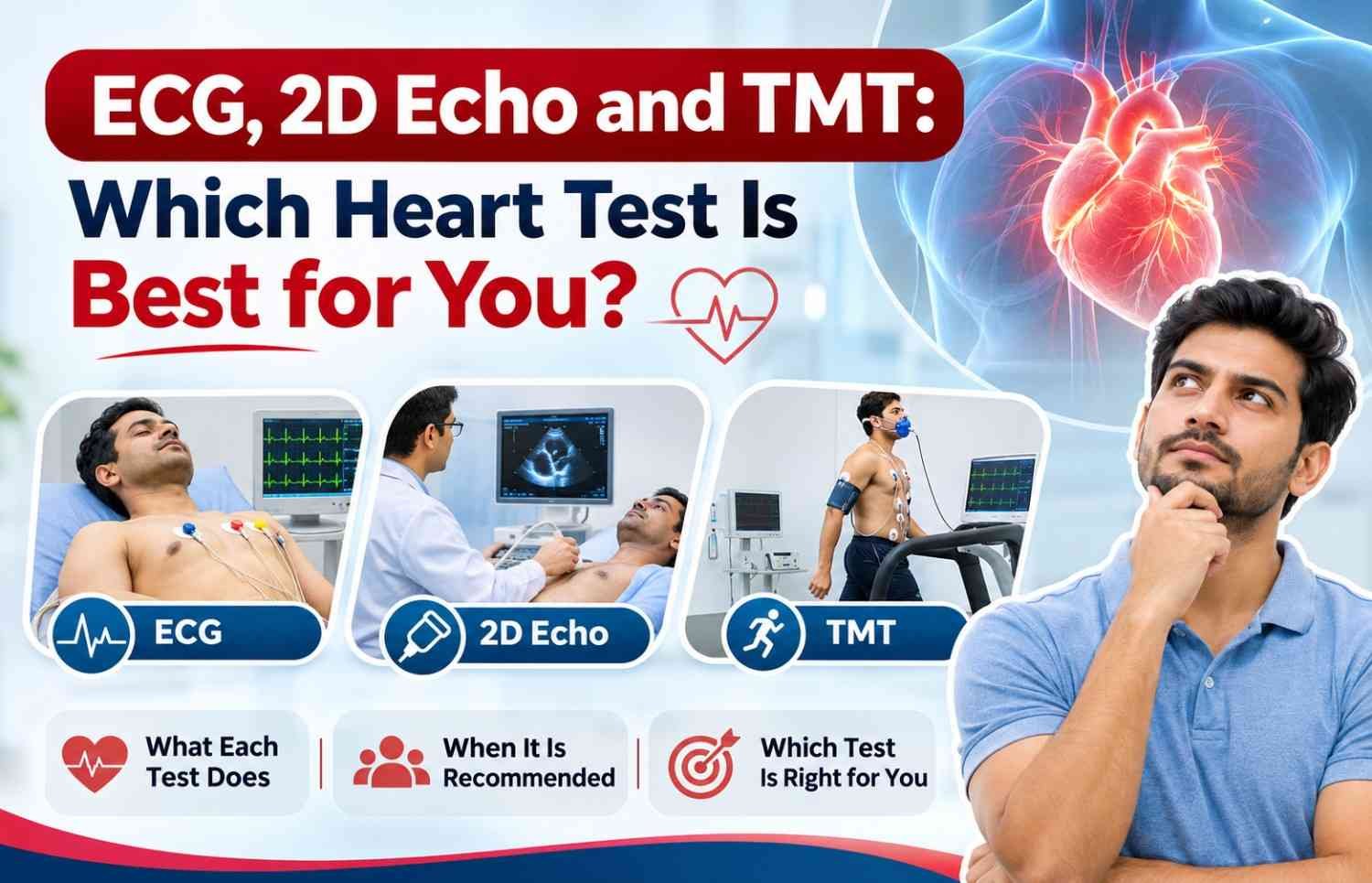
Three commonly recommended cardiac investigations are ECG (Electrocardiogram), 2D Echo (Two-Dimensional Echocardiography), and TMT (Treadmill Test). Although all three tests help assess heart health, they serve different purposes.
Many people wonder which test is best for detecting heart problems. Is an ECG enough, or does a 2D Echo provide better information? When should someone undergo a TMT?
Let’s understand how these tests work, what they detect, and how doctors decide which investigation is appropriate.
What Is an ECG Test and Why Is It Important?
An Electrocardiogram (ECG or EKG) is a simple, non-invasive test that records the electrical activity of the heart. Every heartbeat is controlled by electrical signals, and an ECG captures these signals to help doctors understand the heart’s rhythm and electrical functioning.
During the test, small electrodes are attached to the chest, arms, and legs. These electrodes record the electrical impulses produced by the heart and display them as wave patterns on a monitor or printed report.
An ECG usually takes around 5–10 minutes and does not involve injections or radiation.
What Can an ECG Detect?
An ECG can help identify several heart-related conditions, including:
- Irregular heartbeat (arrhythmia).
- Abnormally fast or slow heart rate.
- Possible signs of a current or previous heart attack.
- Certain electrical conduction abnormalities.
- Changes that may suggest enlargement of heart chambers.
- Possible indications of reduced blood supply to the heart.
When Should You Get an ECG?
A doctor may recommend an ECG if you experience:
- Chest pain or discomfort.
- Palpitations or an unusually fast heartbeat.
- Dizziness or fainting episodes.
- Shortness of breath.
- Unexplained fatigue.
- Suspected heart-related complications.
An ECG is often one of the first investigations performed when someone reports symptoms of a possible heart problem.
However, it is important to understand that a normal ECG does not completely rule out heart disease. Some cardiac conditions may not produce noticeable ECG changes during the test.
What Is a 2D Echo Test?
A 2D Echocardiography (2D Echo) is an ultrasound-based investigation that creates moving images of the heart. Unlike an ECG, which records electrical activity, a 2D Echo allows doctors to examine the heart’s structure, movement, and pumping function.
The test uses high-frequency sound waves to produce images of the heart on a screen. A technician or doctor moves a special ultrasound probe over the chest to capture different views of the heart.
It is generally painless, non-invasive, and does not use radiation. A standard 2D Echo usually takes approximately 20–45 minutes, depending on the examination.
What Can a 2D Echo Detect?
A 2D Echo provides important information about:
- Heart pumping efficiency and ejection fraction (EF).
- Functioning of heart valves.
- Enlargement of heart chambers.
- Weakness of the heart muscle.
- Structural abnormalities.
- Fluid accumulation around the heart (pericardial effusion).
- Certain congenital heart defects.
- Some effects of previous heart attacks.
When Is a 2D Echo Recommended?
Doctors may suggest a 2D Echo when patients have:
- Persistent breathlessness.
- Swelling in the legs or feet.
- Suspected heart failure.
- A heart murmur.
- Unexplained chest discomfort.
- Suspected valve-related problems.
- A history of heart attack or other cardiac conditions.
A 2D Echo is particularly useful when a doctor wants to understand how effectively the heart pumps blood and whether its valves and chambers are functioning properly.
What Is a TMT (Treadmill Test)?
A Treadmill Test (TMT), also called an exercise stress test, evaluates how the heart responds to physical activity.
Unlike an ECG performed while resting, a TMT records the heart’s electrical activity while a person walks on a treadmill. The speed and incline of the treadmill gradually increase according to the patient’s ability and the test protocol.
Throughout the procedure, doctors monitor the heart rate, blood pressure, ECG changes, and symptoms.
The purpose is to identify abnormalities that may become noticeable when the heart needs to work harder.
What Can a TMT Detect?
A TMT may help doctors identify:
- Exercise-related ECG changes suggesting reduced blood supply to the heart.
- Possible signs of coronary artery disease.
- Abnormal heart rhythm during exercise.
- Exercise tolerance and physical capacity.
- Blood pressure response to physical activity.
- Symptoms such as chest pain or breathlessness during exertion.
Who May Need a TMT?
A cardiologist may recommend a TMT for people who:
- Experience chest discomfort during walking or exercise.
- Have suspected coronary artery disease.
- Need evaluation of exercise-related symptoms.
- Require assessment of functional capacity.
- Need further cardiac evaluation based on their medical history and initial test results.
However, a TMT is not suitable for everyone. People with certain heart conditions, severe symptoms, or an inability to exercise safely may require alternative investigations.
ECG vs 2D Echo vs TMT: Key Differences
Although these three investigations evaluate heart health, each focuses on a different aspect of cardiac functioning.
| Feature | ECG | 2D Echo | TMT |
|---|---|---|---|
| Full Name | Electrocardiogram | Echocardiography | Treadmill Test |
| Main Purpose | Electrical activity | Heart structure and pumping | Heart response to exercise |
| Technology | Electrical electrodes | Ultrasound waves | ECG monitoring during exercise |
| Procedure | Resting test | Ultrasound examination | Walking on a treadmill |
| Duration | 5–10 minutes | 20–45 minutes | Around 15–30 minutes |
| Radiation | No | No | No |
Which test provides the most information?
There is no single winner. An ECG evaluates electrical activity, a 2D Echo examines heart structure and pumping function, and a TMT assesses how the heart responds to physical stress.
The right investigation depends on the symptoms, medical history, risk factors, and clinical findings.
Which Heart Test Is Best for You?
Choosing the right cardiac test is not about selecting the most advanced or expensive investigation. It is about identifying the test that answers the doctor’s specific clinical question.
Here are some general examples:
1. If You Experience Chest Pain
An ECG is often an important initial investigation, particularly when chest pain is new or concerning. Depending on the situation, doctors may also recommend blood tests such as cardiac troponin, an echocardiogram, or other investigations.
2. If You Experience Breathlessness
A 2D Echo may be recommended to evaluate the heart’s pumping function, valves, and structure. However, breathlessness can also result from lung conditions and other medical problems.
3. If You Experience Chest Discomfort During Physical Activity
A TMT may be considered for selected patients who can exercise and have an interpretable resting ECG. In some cases, stress imaging or CT coronary angiography may be more appropriate.
4. If You Experience Irregular Heartbeats
An ECG can help identify rhythm abnormalities. If the symptoms occur occasionally and are not captured during a routine ECG, a Holter monitor or other ambulatory heart rhythm monitoring may be recommended.
5. If You Have High Blood Pressure or Diabetes
People with diabetes and high blood pressure have an increased risk of cardiovascular disease. A doctor may recommend cardiac investigations based on symptoms, examination findings, and overall cardiovascular risk rather than automatically prescribing all three tests.
Can You Need All Three Heart Tests?
Yes, in certain situations, a cardiologist may recommend ECG, 2D Echo, and TMT together.
For example, if someone experiences recurring chest discomfort, breathlessness, and reduced exercise tolerance, different investigations may help evaluate different aspects of the problem.
- ECG checks electrical activity and heart rhythm.
- 2D Echo examines heart structure and pumping function.
- TMT evaluates the heart’s response to physical exertion.
However, undergoing all three tests is not necessary for every patient. The doctor decides the appropriate combination based on the suspected condition and the patient’s health status.
It is also worth remembering that these tests have limitations. Even normal results cannot rule out every type of heart disease.
When Should You Consult a Heart Specialist?
Ignoring recurring heart-related symptoms can delay diagnosis and treatment. You should seek medical evaluation if you regularly experience chest discomfort, unusual tiredness, palpitations, dizziness, or breathlessness.
If you experience sudden chest pressure or pain, severe breathlessness, cold sweating, fainting, or discomfort spreading to the arm, back, neck, or jaw, seek emergency medical care immediately. Do not wait for a routine appointment or diagnostic test.
Consulting an experienced cardiologist in Gorakhpur can help you understand your symptoms and determine which cardiac investigations are necessary.
If you are searching for a qualified heart doctor in Gorakhpur, consider a cardiologist who can evaluate your medical history, assess cardiovascular risk factors, and recommend appropriate diagnostic and treatment options.
How to Prepare for ECG, 2D Echo and TMT
Preparation depends on the type of investigation.
- ECG: Usually requires no special preparation. Wear comfortable clothing and follow the technician’s instructions.
- 2D Echo: A standard echocardiogram generally does not require fasting. Wear comfortable clothing.
- TMT: Wear comfortable walking shoes and loose-fitting clothes. Follow your doctor’s instructions regarding meals, caffeine, and medications. Never stop prescribed heart medication without medical advice.
Always inform your doctor about existing medical conditions, current medications, and previous heart-related problems before undergoing any investigation.
Conclusion
ECG, 2D Echo, and TMT are three valuable diagnostic tools that help doctors evaluate different aspects of heart health. An ECG checks electrical activity, a 2D Echo examines the heart’s structure and pumping ability, while a TMT assesses the heart’s response to physical exercise.
No single test is best for everyone. The right choice depends on your symptoms, medical history, and the condition your doctor wants to investigate.
If you have persistent heart-related symptoms or risk factors such as diabetes, high blood pressure, smoking, or a family history of heart disease, do not ignore them. Timely consultation with a cardiologist can help identify potential problems and guide appropriate care.
Take care of your heart today because early evaluation can make a meaningful difference to your long-term health.
About the Author